|
Epistatic Effects
as a Confounding Factor: Deciphering the Genetics of the Gimpeltaube
When a rare coloration appears unexpectedly, the question
immediately arises: is it dominant or recessive? There is no simple
answer. Colorations result from combinations of genetic factors; it
is these factors—not the colorations themselves—that can be dominant
or recessive relative to the wild type (the blue-bar rock pigeon).
Rare colorations are usually embedded within other color
combinations—for instance, in conjunction with bronze tones, pied
patterns, and the like. To answer the question from a genetic
perspective, the factor must first be isolated and then tested.
However, the breeder’s perspective differs from that of the
geneticist. Breeders want to know whether mating a bird with another
color variety will yield interesting color effects in the very first
cross. If it does, they describe the inheritance as dominant; if
not, they call it recessive.
During the early stages of deciphering color inheritance in pigeons
after 1900, this led to confusion, even within scientific studies.
At that time, little was known about epistatic effects in
pigeons—where certain factors are required for others to manifest,
while some block others. In 1926/1928, Metzelaar classified the
"bronze" trait of Archangel pigeons (Blackwing Gimpel Pigeon) among
the dominant "Kite factors," which affect specific feather
regions—in the case of Archangels and other Gimpel Pigeon
variations, the bird's base body plumage. When crossing Black-winged
Gimpels with solid black pigeons, Horlacher concluded in 1930 that
the trait followed a recessive inheritance pattern; this was
confirmed in 1931 by Bjaanes following crosses with solid red and
solid black birds. At the time, neither researcher was aware that
the color-spreading factor known as "Spread" blocks (masks) the
bronze trait found in Blackwings. This also applies to homozygous
Recessive Red birds; well-colored Recessive Reds typically possess a
black base color combined with the Spread factor. The same holds
true for Recessive Yellows. Consequently, the bronze trait can be
subject to a dual blocking effect. This occurs partly through
homozygosity for recessive red and also through the spread factor.
It took a long time for the erroneous assessment in the literature
to be corrected.
Crosses between Copper Black-wings and Blue-checkered or Blue-barred
birds demonstrate that the black wings of Copper and Gold
Black-wings are not attributable to the ‘Spread’ gene. Spread is
dominant and asserts itself in the first cross; a homozygous Black
bird mated with a Blue or Blue-check produces black offspring.
Mating a Black-wing with a blue-bar or blue-check yields blue bar
and blue-check offspring displaying varying degrees of bronze on the
breast and in the rest of the body plumage. In the subsequent
generation (F2), the bronze coloration extends to the head and belly
plumage in some individuals. The dark factors responsible for the
black wing coverts reassert themselves in backcrosses. When
backcrossed to blackwings, some of the resulting hybrids are
indistinguishable from purebred blackwings to the untrained eye.
A
cross similar to the one performed by Bjaanes was replicated years
ago by Heinrich Schröder using a gold black-wing and a
recessive-yellow Moravian Strasser hen. Spread was inherited from
the Strasser hen, resulting in a "pale-black" offspring with a hint
of gold shimmering on the breast. The Gold Archangel Black-wing was
heterozygous for recessive red, which accounts for the
golden-colored young female.
Literature:
Bjaanes, M., A new dilution factor in pigeons
by W. Christie † and C. Wriedt †, Hereditas, Vol. 15 (1931), pp.
89-96.
Horlacher, W.R., Studies on Inheritance of
Pigeons. VII. Inheritance of red and black color pattern in pigeons.
Genetics 15 (1930), pp. 312 ff.
Metzelaar, Jan, Further Experiments in
Inheritance of Color in Domestic Pigeons, Occasional Papers of the
Museum of Zoology, University of Michigan. Number 194, April 4,
1928, pp. 1-29
Sell, Axel, Genetik der Taubenfärbungen, Achim
2015
Sell, Axel, Pigeon Genetics. Applied Genetics
in the Domestic Pigeon, Achim 2012
Sell, Axel and Jana Sell, Genetic of the
Domestic Pigeon, Achim 2025
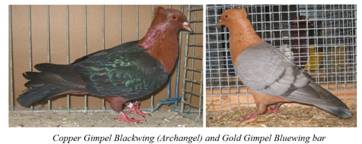
Source: Sell, Axel and Jana Sell, Genetics of
the Domestic Pigeon, Achim 2025
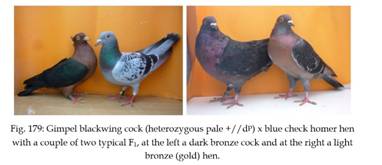
Source: Sell, Axel, Pigeon Genetics. Applied
Genetics in the Domestic Pigeon, Achim 2012. Fotos from the own loft
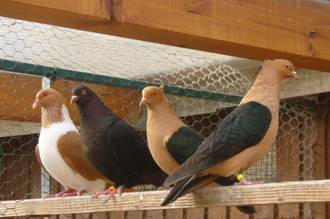
Cross between a gold-black-wing
and a yellow Moravian Strasser hen. Second from the left: a
pale-black crossbred bird with a slight golden tint on the breast
from the loft of Heinrich Schröder
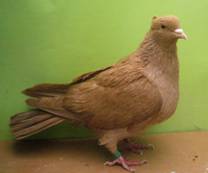 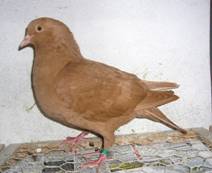
Homozygous recessive gold
(recessive red plus pale) from a pair of Gold Black-wings, and a
young gold female from the mating of a Gold Black-wing and a
Moravian Strasser hen, from the loft of Heinrich Schröder.
|
