|
Hereditary factors hidden under dominant white in
the domestic pigeon
Approximately 100 years ago, Joseph R. Walker described 'dominant
white' in pigeons as a factor that, in homozygous state, produces a
white or nearly white pigeon. In heterozygousity, it results in a
largely white pigeon, but one that always retains a noticeable
amount of color (Walker 1925, 603). Unlike recessive white pigeons,
they would not have dark eyes. Dominant whites with dark eyes would
be just as rare as dark-eyed colored pigeons (p. 594). His tested
birds usually had some color in their juvenile plumage, which molted
completely to white in homozygous and partially in heterozygous
birds. The varying degree of white coloration in the initial cross
and in subsequent breeding may be due not only to the genes of the
different breeding partners but also to the hereditary factors
present epistatically under and beside the dominant white. And these
can vary from individual to individual, as the following examples
demonstrate.
White Pomeranian Eye-Crested Highflyers in a
Breeding Project
The epistatic effect in dominant white pigeons was demonstrated
incidentally decades ago (Sell 1980, 2012). The project involved
breeding differently colored Eye-Crested Highflyers from dominant
whites by mating with blue Danish Tumblers and Danzig Highflyers.
All of these breeds possessed the smoky factor, a prerequisite for
the desired light beak color. The dominant white factor was
confirmed when a dominant white male was mated with a blue Danzig
hen. The resulting offspring were an almost completely white hen and
a white male with red speckling in the neck area (Fig. 1).
Fig. 1: Dominant White
in a Breeding Project
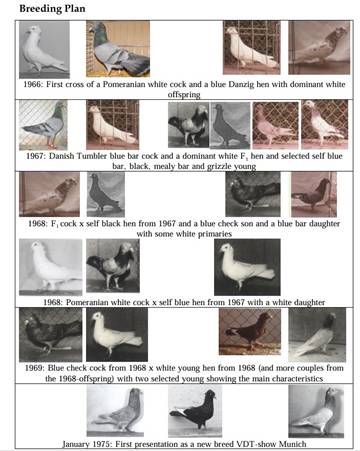
Source: A. Sell,
Pigeon Genetics, Achim 2012
This invalidates the claim that all white pearl- and orange-eyed
pigeons are homozygous dominant ash red and also homozygous for the
grizzle factor. They can be white as is shown by the daughter even
without homozygosity for the grizzle factor. Furthermore,
heterozygosity for the black base color in young males does not
preclude white coloration.
The white hen from the initial cross, when subsequently mated with
the blue Danish Tumbler, showed in her ash red son that she had
inherited the dominant ash red base color from her father (second
image bar in Fig. 1). In the black young hen, she also showed that
she possessed the color spreading factor. This, too, must have
originated from the father. The same applies to the grizzle factor,
which one of her offspring exhibits.
The merging of the line of the white parent cock in the third
breeding year by mating the white cock with speckling from the
initial cross with a solid black niece from the second breeding year
revealed two further hereditary factors in the checkered cock and in
the white pied feathers of the blue young hen (third image bar in
Fig. 1). These factors must have originated from the white parent
cock. In the parent cock, they were masked by the dominant white.
Only years later did the Platinum color variety unexpectedly emerge
from these parent family, a color variety that, through the
interaction of a recessive factor with the color spreading factor,
produces a platinum-gray coloration.
Dominant White in Crosses with Stralsund Highflyers
The mating of a white Stralsund Highflyer in a flying strain with a
blue-check racing homer hen in our own loft resulted in an almost
white offspring and a black-tiger one (Fig. 2). This shows that
completely white pigeons, like the male, can be at least
heterozygous for black base color, and that the male carried the
color-spreading factor. Even from purely white pairs, mottled and
pencil-like offspring occasionally appear, which also exhibit the
black base color in at least one of the parents (Fig. 2, right).
Walker had mentioned dark eyes in Dominant Whites. The recessive
white with dark eyes also appears to be epistatically hidden within
Dominant Whites, as this phenomenon has also occurred in our own
Stralsund Flying strain. The same applies to the dilution factor in
diluted (short-downed) Dominant Whites.
Fig 2: Stralsund
flying type x blue check Racing Homer hen with their youngsters, and
a black laced youngster from a couple of complete white Stralsund
parents from the own loft (photo right)
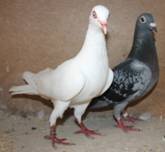 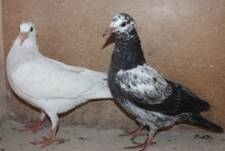 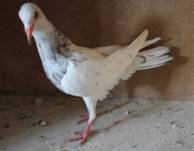 . .
Source: A. Sell, Critical Issues in
Pigeon Breeding, Part V, Achim 2021
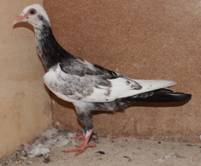
Crossbreeding of an exhibition Stralsund white cock with a recessive
red Stargard Highflyer hen at Alwin Nüske's loft resulted in
offspring near to white and black mottled. The black coloration is
likely due to the genetically black base color of the recessive red
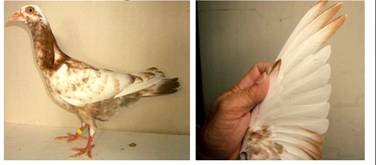
Stargards (Fig. 3). The reverse pairing of a dominant white
Stralsund male with a recessive red Stargard female showed in the
primaries the transformation of the initially reddish plumage to
pure white (Fig. 4), as already described by Walker.
Fig. 3: Youngster
from recessive red Stargard Highflyer x dominant white Stralsund hen
and Fig. 4: youngster from dominant white Stralsund cock x recessive
red Stargard Highflyer hen. At the right shown the moulting to white
Breeder: Alwin Nüske
Some findings
Dominant Whites, as a color variety, can possess different gene
combinations. Not all of these genes are required for the white
coloration. In the exhibition world, most Dominant Whites appear to
have a dominant ash red base color. Those shown here, recognizable
by the coloration of subsequent generations, also the Spread factor.
The former is likely related to the fact that with an ash red base
color, the risk of undesirable darkening of the beak is lower than
with a black base color. The significance of the spread factor is
open to speculation; in practical breeding, a corresponding
selection will take place.
Literature:
A.
Sell, Pigeon Genetics, Achim 2012
A.
Sell, Vererbung bei Tauben, Traventhal 1980
J.R. Walker, Inheritance of white Plumage in Pigeons, Genetics 10
(1925), pp. 593-604.
|
